
Robots & Babies - Part 2
In a world with a fertility crisis, can AI help us? Or will it be our doom?
$500,000,000,000
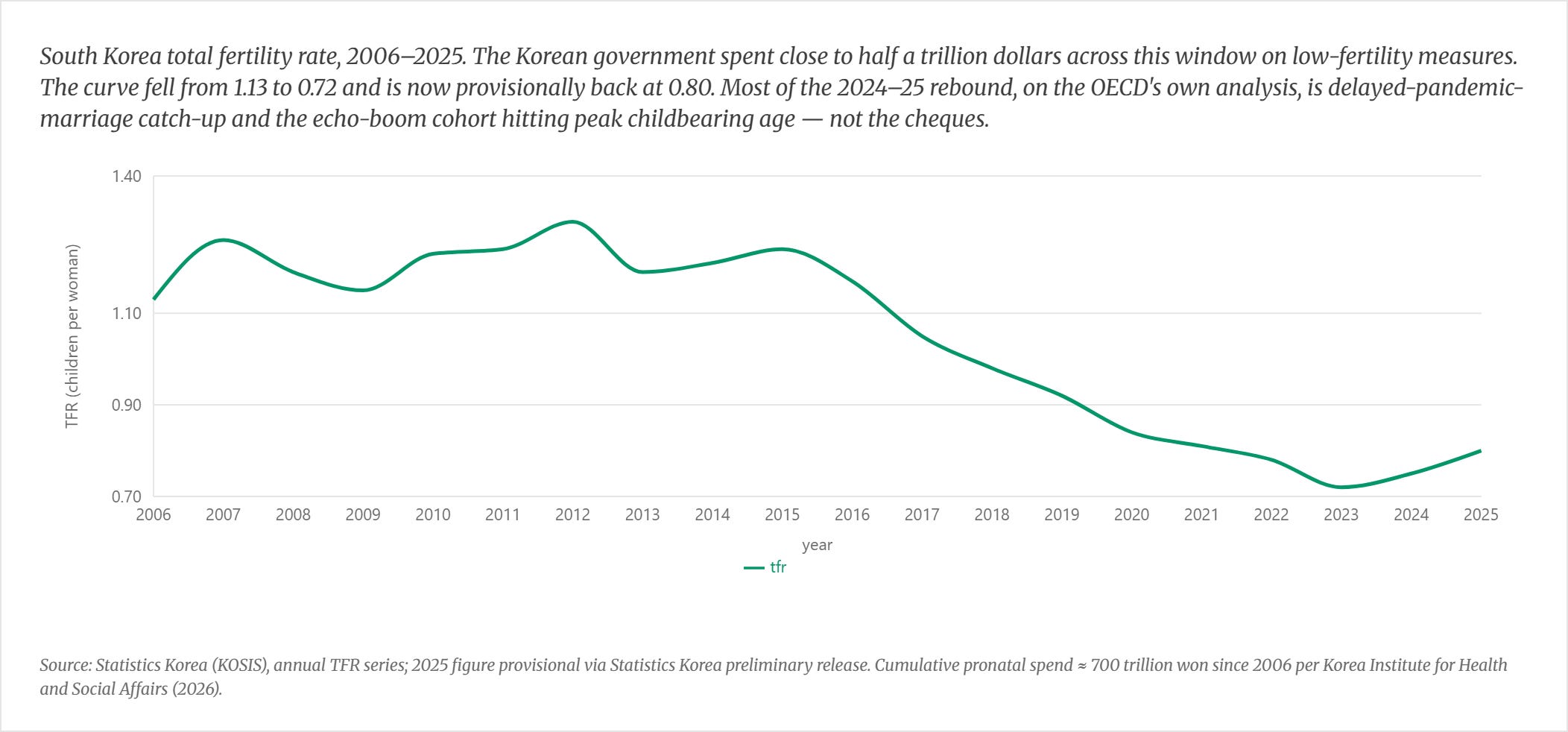
That is roughly what South Korea has spent on pro-natal policy since 2006. Over the same period, its fertility rate fell from 1.13 to 0.80.
Hungary spends around 5% of GDP on family policy; the rate fell anyway.
France, Europe’s celebrated model, sits below replacement and drifting lower.
The only rich country comfortably above replacement, Israel, is there for religious and historical reasons that no other government can legislate into existence.
In Part 1 I argued this is not a story about the size of the cheque you give parents. It is a story about clocks - four of them.
A capital clock that runs in quarters.
A policy clock that runs in election cycles.
A household-formation clock that runs in decades.
And a fertility clock, the only one that matters, that runs in generations
A decision made tonight to have a child isn’t vindicated or refuted in the data until the 2070s, long after everyone currently arguing about it has been judged on some faster clock and moved on.
Which leaves the question Part 1 left hanging:
What Do We Do?
The standard read of all this is “not enough money.”
I would argue something different:
No amount of money paid on a five-year window can move a sixty-five-year variable.
The people writing the cheque are evaluated long before the people receiving it have grown up. A government that needs to demonstrate impact within an election cycle has every incentive to fund interventions visible inside that cycle and no incentive to fund interventions whose payoff lands three administrations later. The mechanism actively selects for the wrong policy.
AI is the Accelerant
AI doesn’t change the clocks. It just widens the gap between them, on every channel that matters.
The capital clock runs faster.
Goldman Sachs estimates 300 million jobs globally are exposed to AI automation, with 6–7% of workers displaced over a decade in their base case.
Indeed’s Hiring Lab projects US unemployment could rise 3.5% by 2040 in their AI-replacement scenario. A structural mismatch their team is openly calling “the great mismatch.”
A 25-year-old today is meant to feel stable enough by 30 to plan a family. The capital cycle she is being asked to survive is shortening exactly while the household-formation sequence she needs to complete remains stubbornly the same length. The two timelines are pulling apart in real time.
The labour clock churns faster.
CSET’s analysis of higher education and workforce pathways describes credentials and apprenticeships degrading faster than institutions can rebuild them. The bottom rung of the career ladder
The underpaid junior role that used to absorb a 22-year-old long enough to teach her the craft, is the rung most exposed to AI substitution.
When the bottom rung disappears, the people who used to climb it don’t suddenly become senior; they remain stuck below the ladder.
Every year someone spends below the ladder is a year subtracted from the household-formation window.
Labour markets and parenthood share a substrate. Damage one and you damage the other.
The meaning clock (the slow one) is moving too.
John Burn-Murdoch’s recent FT piece on phones and fertility points to a working paper by Hudson and Moscoso-Boedo at the University of Cincinnati that pegs digital technology at 43% of the post-2007 US fertility decline.
Smartphones did not arrive everywhere at once, and birth rates dropped on schedule wherever they did. AI companionship is the next turn of the same screw, and a faster one.
Character.AI alone reported 233 million registered users and 20–30 million monthly actives, with surveys finding that a majority of its Gen Z users report some form of emotional connection with an AI character.
The smartphone took fifteen years to register clearly in the demographic data. The companion app may take less.
Three clocks, all running faster than the one that actually produces children. The gap widens; the policy lever still reaches for the wrong shelf.
The honest counter-argument
The strongest version of the opposite case is worth stating fairly.
AEI’s September 2025 piece AI’s Baby Bonus? argues that AI productivity may be the only realistic lever left, because if the gains are large enough, household income rises fast enough to make children affordable again.
Liang Jianzhang, writing in Caixin in May 2026 from Beijing, makes a structurally similar argument with a different policy mix: AI is both the threat and the only available bridge.
Both are serious arguments and the bridge case has internal consistency. If AI productivity translates into broad-based wage growth and the tax base it generates is recycled into household support at scale, the cost line on raising a child finally bends, and parameter levers start working at the margin because the margin has finally moved.
So let’s take it seriously and evaluate. Even if the AI dividend lands as promised, it lands on a household that has to decide now, on the basis of an economic future that won’t be visible until the kid is in college.
Productivity gains can’t time-travel. The young adult weighing a first child in 2032 cannot price a 2048 economy that depends on whether AI capex compounds into broad productivity, whether redistribution is politically feasible, whether the labour market for her hypothetical 22-year-old in 2054 still exists in any recognisable form.
She has to bet, and the rational bet on incomplete information about a faster clock is to defer, to wait. AEI’s mechanism, even granted, would only show up in fertility data on a horizon long enough that the cohort being targeted has already made its decision.
There is a second problem the bridge argument tends to skip past, which the NY Fed Liberty Street post quietly underlines: in Q3 2025 the productivity gains were going into capex, not into wages.
All the benefits of AI are growing on corporate balance sheets rather than going to the employees households. Even the optimistic story requires a redistributive mechanism that does not yet exist and would itself take a decade to legislate, design, and route to the people whose fertility decisions are being made today. The clock problem is recursive: even the solution to the clock problem has its own clock.
The best result to keep an eye out for is a Fertility Rate rebound in the most AI-saturated economies inside a decade — tech-corridor regions, Nordic knowledge-economy hubs, Singaporean engineering cohorts, Korean metropolitan professionals.
I’d bet against it, but you can take the bet.
If those areas of the world are showing fertility recovery panel-by-panel by 2034, the case of AI being a ‘bridge’ has earned its place. If they are not, then we should stop pretending the problem is something we can solve with AI.
The Buck Stops Here
Stop scoring fertility policy on five-year windows. Stop reading AI as a fertility variable that resolves on tech-press cycles. Stop arguing about the size of the cheque on a clock that cannot reach the variable the cheque is meant to move.
The question worth asking is: what humans are for, in 2048, when the economy may not need them as labour?
A baby born this week is the only actor in the system whose timeline is honest about how long the answer takes. Everyone else is reading the wrong clock.


